

Adhesive Tape Holding Power Test: Room vs. High Temperature


Holding power shows how well a pressure-sensitive adhesive tape resists movement under a sustained shear load.
It is different from initial tack and peel adhesion because it focuses on how the bond performs over time while a constant load is applied parallel to the bonded surface.
For mounting, fixing, industrial assembly and other applications involving continuous load, holding power is an important part of tape performance evaluation.
YG Group tests tape holding power under both room-temperature and elevated-temperature conditions to compare adhesive constructions and support product selection.
Quick Answer: What Does a Holding Power Test Measure?
A holding-power test bonds a tape specimen to a test panel, applies a constant load and records either:
Time to Failure — how long the specimen remains bonded.
Displacement — how far the specimen moves during a defined test period.
This is also commonly called a static shear adhesion test.
A longer time to failure or smaller displacement may indicate stronger static shear resistance — but only when the test conditions are equivalent.
Room Temperature vs. High Temperature Holding Power
Both tests measure static shear performance, but under different temperature conditions.
| Test | What It Evaluates |
|---|---|
| Room-Temperature Holding Power | Static shear behavior under controlled ambient conditions |
| High-Temperature Holding Power | Static shear behavior at an elevated test temperature |
For the YG Group demonstration:
Room-Temperature Preparation
23°C ± 1°C / 50% RH ± 5%
High-Temperature Test
80°C
Applied Load
1 kg
At elevated temperatures, some pressure-sensitive adhesives may show more creep or movement under load.
Important: Passing an 80°C holding-power test does not mean the tape automatically has an 80°C service-temperature rating.
Actual performance also depends on the substrate, load, exposure time and application conditions.
Watch the Holding Power Test
The video shows the complete test process:
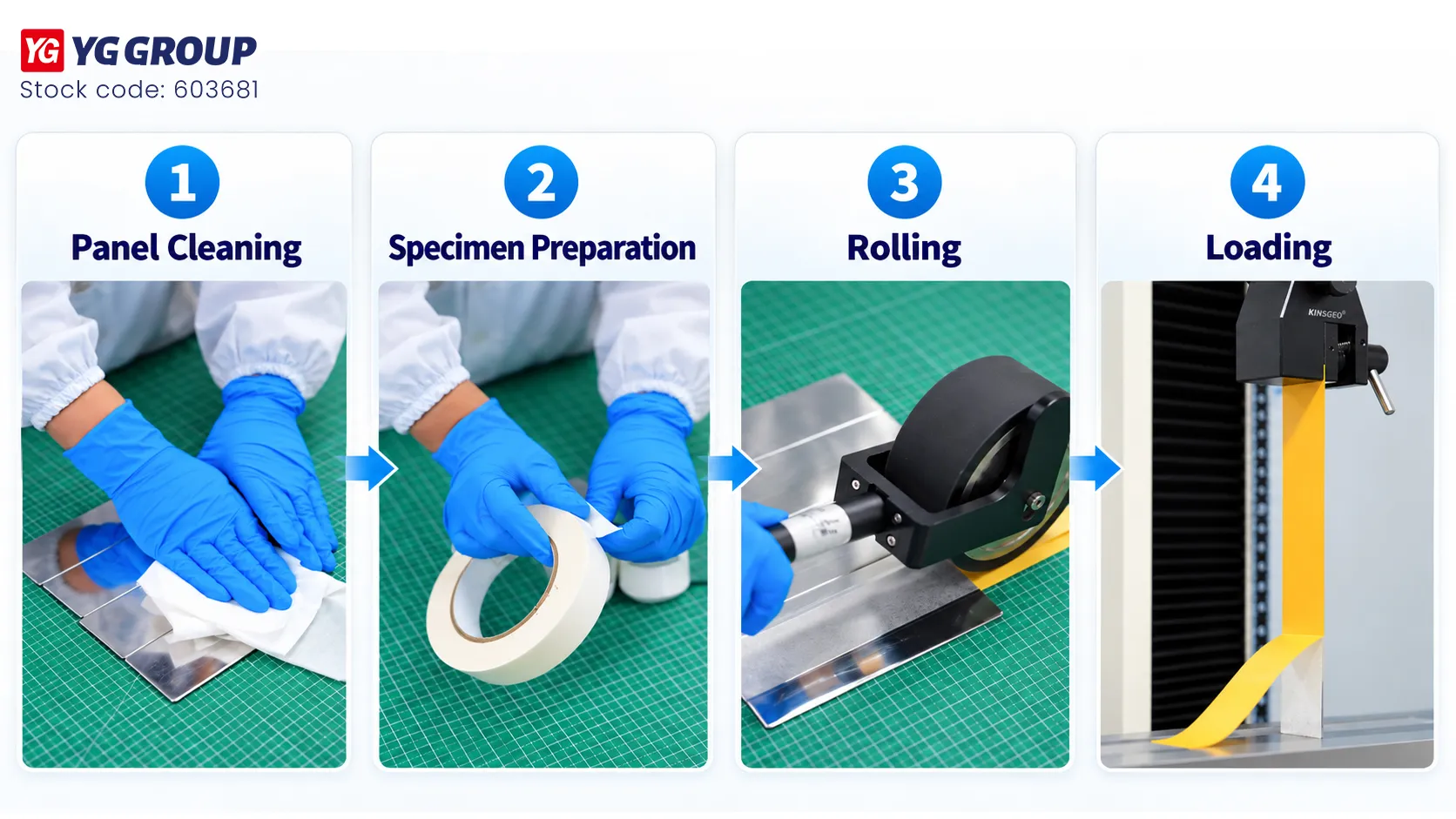
Conditioning → Panel Cleaning → Specimen Preparation → Rolling → Dwell → Loading → Result Recording
Both room-temperature and elevated-temperature tests are included.
Test Conditions Used in This Demonstration
| Parameter | Condition |
|---|---|
| Specimen Conditioning | ≥24 h |
| Preparation Environment | 23°C ± 1°C / 50% RH ± 5% |
| Specimen Size | 25 mm × 150 mm |
| Bonded Area | 25 mm × 25 mm |
| Load | 1 kg |
| Dwell Time | 20 min |
| High-Temperature Test | 80°C |
| Result | Time to failure or displacement |
These conditions apply to the specific test shown in the YG Group video.
Different products or customer test methods may use different parameters.
How Is the Holding Power Test Performed?
The full laboratory procedure is shown in the video. The main process can be summarized in six steps.
1. Condition the Tape
Condition the specimens in the controlled test environment for at least 24 hours before testing.
2. Clean the Steel Panel
Clean the steel panel with anhydrous ethanol and lint-free material to remove oil, dust and other contamination.
3. Prepare the Specimen
For the double-sided tape shown in the video:
Specimen: 25 mm × 150 mm
Bonded Area: 25 mm × 25 mm
Reinforcement: 25 μm PET film
The adhesive test area should not be touched directly.
4. Apply and Dwell
Apply the specimen using the test roller and allow it to dwell for:
20 minutes
before loading.
5. Apply the Load
Mount the panel vertically and attach a:
1 kg load
For the high-temperature test, place the specimen inside the heated test chamber.
6. Record the Result
Record either:
Time to Failure or
Displacement After the Defined Test Period
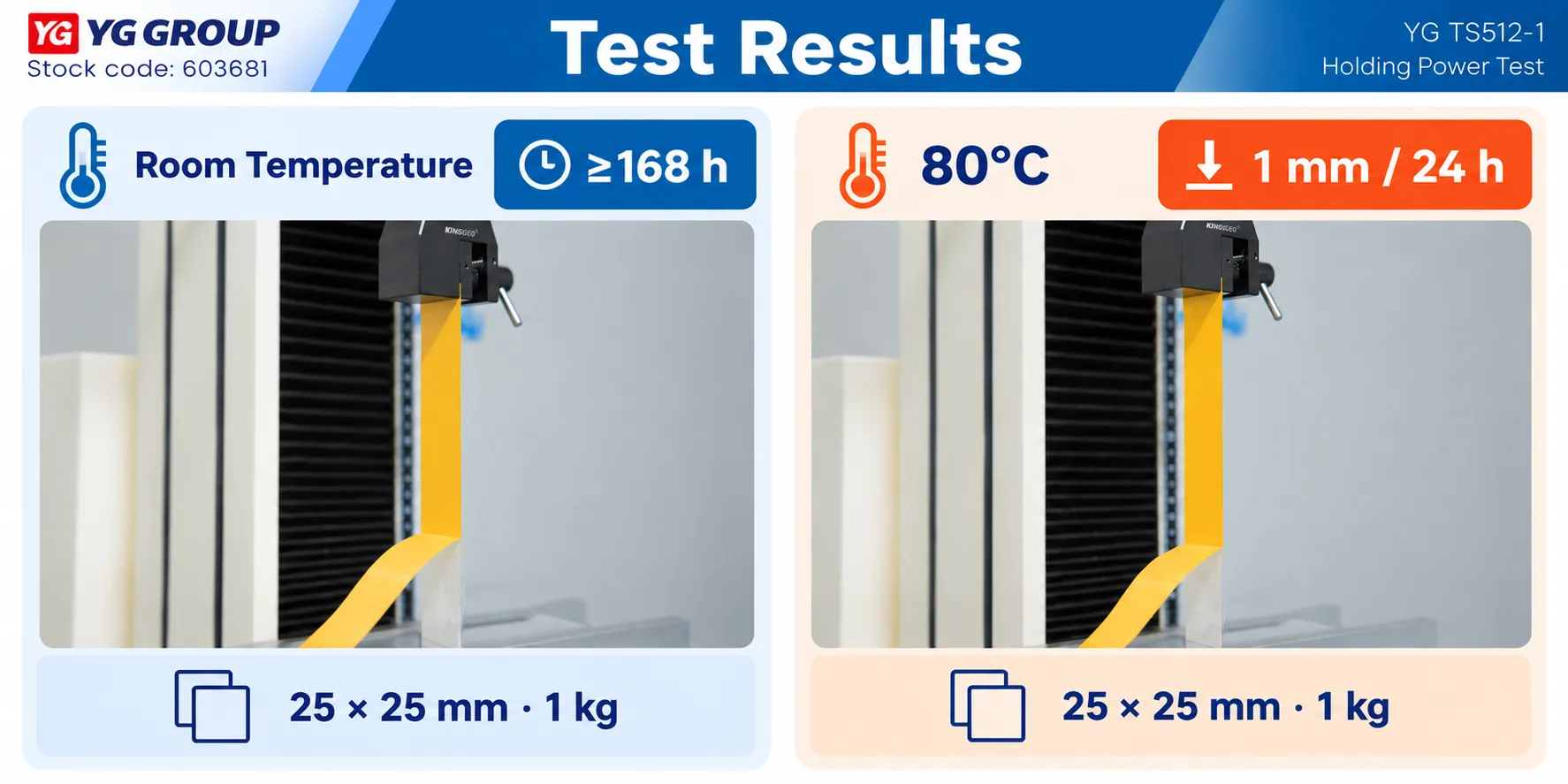
YG TS512-1 Demonstration Results
Room-Temperature Test
Bonded Area: 25 mm × 25 mm
Load: 1 kg
≥168 Hours Without Failure
The demonstrated specimen remained bonded for at least 168 hours under the stated room-temperature test conditions.
High-Temperature Test
Bonded Area: 25 mm × 25 mm
Load: 1 kg
Temperature: 80°C
Duration: 24 h
1 mm Displacement After 24 Hours
The specimen moved 1 mm during the defined 24-hour test at 80°C.
These are demonstration results under the stated conditions, not universal product specification limits. Refer to the current TDS for product specifications.
How Should You Read a Holding Power Result?
A result such as:
Holding Power: 168 h
does not provide enough information by itself.
A more useful result is:
≥168 h without failure — 25 mm × 25 mm bonded area, 1 kg load, room-temperature condition
Likewise:
1 mm displacement after 24 h at 80°C — 25 mm × 25 mm bonded area, 1 kg load
provides the conditions needed to understand the result.
Before comparing two tape products, check:
Bonded Area + Load + Substrate + Dwell Time + Temperature + Test Duration
If these parameters are different, the results may not be directly comparable.
Simple Rule
Holding Power Result = Test Value + Test Conditions
The number alone does not tell the full story.
Holding Power vs. Peel Adhesion vs. Tack
Holding power is only one part of adhesive performance.
| Property | What It Evaluates |
|---|---|
| Initial Tack | Initial contact with the substrate |
| Peel Adhesion | Resistance to peeling |
| Holding Power | Resistance to sustained shear loading |
A tape with higher holding power is not automatically the better choice for every application.
For example, removable masking tape and permanent mounting tape require different performance balances.
The more useful question is:
Does the tape meet the requirements of the actual application?
Why Test Holding Power at High Temperature?
Higher temperatures can change the way some pressure-sensitive adhesives behave under sustained load.
High-temperature holding-power testing can therefore be useful for applications involving:
- Automotive components
- Electronics
- Industrial mounting
- Appliances
- Elevated-temperature manufacturing environments
The test helps show whether the bonded specimen resists excessive creep under the defined temperature and load.
Actual field performance still depends on:
Temperature + Exposure Time + Substrate + Load + Bonded Area
For mounting and fixation applications, buyers can also review YG Group's Double-Sided Tape range.
Which Standards Are Relevant?
This demonstration references GB/T 4851-2014 for adhesive-tape holding-power testing.
Related international static shear methods include:
- ISO 29863:2018
- ASTM D3654/D3654M
These methods evaluate the same general performance property, but individual procedures and reporting conditions may differ.
YG Group is also participating in the ongoing revision of GB/T 4851.
For technical comparison, always confirm:
Test Method + Test Conditions + Result Format
rather than comparing only the final number.
YG Group Adhesive Tape Testing Capability
YG Group operates a CNAS-accredited testing center and has testing capabilities covering areas such as:
- Tack
- Peel adhesion
- Holding power
- Tensile properties
- Other adhesive-material evaluations
The applicable accredited scope should be confirmed for each individual test item.
Testing can support a more complete product-evaluation process:
Product Specification → Laboratory Test → Application Conditions → Sample Evaluation
For more information, see YG Group R&D and Testing Capability.
What Information Should Buyers Provide?
For a tape recommendation or technical comparison, provide:
- Tape type or current product
- Bonding substrate
- Expected load
- Application temperature
- Service temperature
- Required holding time
- Indoor or outdoor use
- Existing TDS or sample, if available
For high-temperature applications, provide:
Temperature + Exposure Duration + Load
instead of only requesting a “high-temperature tape.”
Frequently Asked Questions
What is adhesive tape holding power?
Holding power measures how well a bonded tape resists movement or failure under a sustained static shear load.
Is holding power the same as peel adhesion?
No. Peel adhesion measures resistance to peeling, while holding power evaluates resistance to sustained shear loading.
How is holding power reported?
It is usually reported as time to failure or displacement after a specified test period.
Does passing an 80°C test mean the tape can be used continuously at 80°C?
No. The result describes performance under the stated laboratory conditions. Actual service suitability depends on the complete application.
Can holding-power values from different suppliers be compared directly?
Only when the relevant test conditions are equivalent.
Check the bonded area, load, substrate, dwell time, temperature and test duration before comparing results.
Need Tape Testing or Sample Evaluation?
For a new project, send YG Group:
Tape Type → Substrate → Load → Temperature → Required Holding Time → Application
YG Group can review suitable tape constructions, technical data, samples and relevant test requirements.